
Anamorphic advertising is redefining how brands capture attention in crowded urban environments. Unlike traditional hoardings, this format uses forced perspective and advanced 3D content to create visuals that appear to leap out of the screen. As a result, viewers experience a powerful optical illusion without wearing special glasses. In India, where outdoor media competes fiercely for attention, anamorphic 3D billboards are emerging as a high-impact solution. Moreover, with rapid urbanisation and digital infrastructure growth, Indian cities are becoming ideal playgrounds for this immersive format.
What Is Anamorphic Advertising?
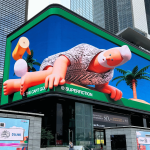
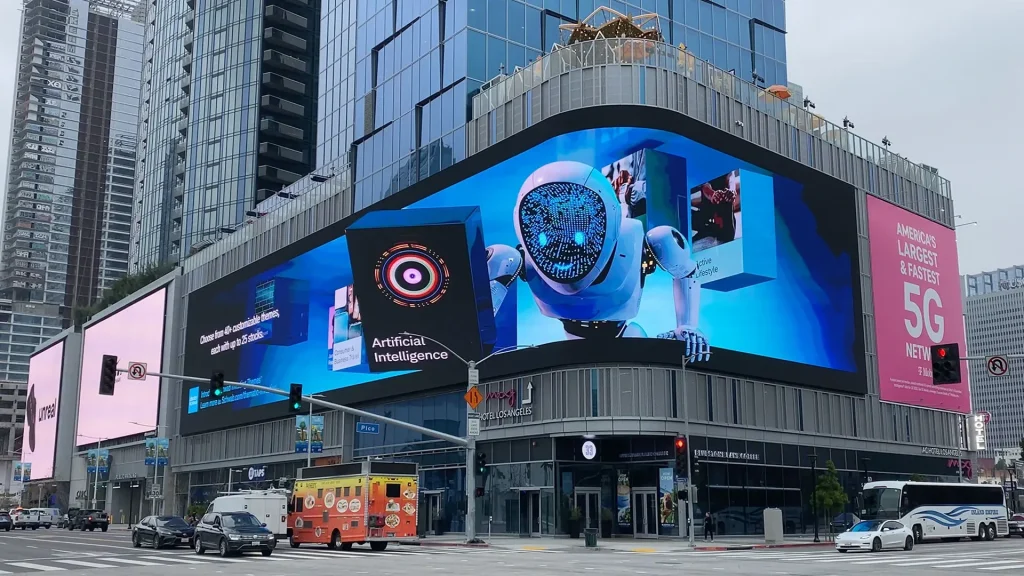
Anamorphic advertising refers to a specialised visual technique where 3D content is designed for a specific viewing angle. When seen from that angle, the content appears three-dimensional and hyper-real. However, from other angles, it may look distorted. This calculated distortion is intentional and forms the core of anamorphic design. Therefore, brands use this method to create jaw-dropping outdoor experiences that stop people mid-scroll and mid-commute.
How 3D Billboards Work Using Anamorphic Technology
Anamorphic 3D billboards rely on high-resolution LED screens, precise architectural measurements, and custom motion graphics. First, the billboard’s corner placement or curved surface is mapped digitally. Next, designers build content that aligns perfectly with the viewer’s line of sight. Consequently, the illusion feels natural and immersive. In addition, these billboards often integrate motion, depth, and lighting effects to enhance realism.
Why Anamorphic 3D Billboards Are Gaining Popularity in India
India’s outdoor advertising landscape is evolving rapidly. Firstly, metros like Mumbai, Delhi, Bengaluru, and Hyderabad have a high concentration of premium DOOH inventory. Secondly, Indian audiences are highly visual and social-media driven. As a result, anamorphic billboards naturally generate organic shares, reels, and viral moments. Furthermore, brands now seek experiences, not just impressions. Therefore, 3D outdoor advertising fits perfectly into modern media planning strategies.
Key Benefits of Anamorphic Outdoor Advertising
Anamorphic advertising delivers multiple advantages for brands aiming to stand out. To begin with, it offers exceptionally high attention value compared to static hoardings. Moreover, it improves brand recall because viewers remember unique visual experiences longer. Additionally, these campaigns often blur the line between outdoor and digital marketing, as passersby record and share content online. Hence, a single billboard delivers both physical and digital reach.
Industries Using 3D Billboards in India
Several industries are already leveraging anamorphic 3D billboards in India. For instance, automobile brands use them to showcase vehicle launches dynamically. Similarly, OTT platforms promote new shows using larger-than-life characters. Meanwhile, consumer electronics, gaming brands, and luxury labels use anamorphic advertising to signal innovation and premium positioning. Consequently, this format is no longer experimental but strategically mainstream.
Role of DOOH in Scaling Anamorphic Advertising
Digital Out-of-Home (DOOH) plays a crucial role in scaling anamorphic advertising across India. Because DOOH allows dynamic content scheduling, brands can rotate multiple creatives throughout the day. Additionally, programmatic DOOH enables smarter media buying based on time, traffic, and audience profiles. Therefore, anamorphic 3D content combined with DOOH technology delivers both spectacle and efficiency.
Challenges and Considerations Before Execution
Although impactful, anamorphic advertising requires careful planning. Firstly, not all locations are suitable for forced perspective designs. Secondly, production costs are higher than regular outdoor creatives. However, when executed correctly, the return on attention justifies the investment. Hence, brands must prioritise location selection, viewing angles, and content quality.
The Future of 3D Outdoor Advertising in India
The future of anamorphic advertising in India looks promising. As LED costs decline and creative expertise grows, more tier-1 and tier-2 cities will adopt this format. Moreover, integration with AR, AI-driven creatives, and real-time triggers will further enhance engagement. Therefore, anamorphic 3D billboards are set to become a defining element of next-generation outdoor media.