
The future of outdoor advertising in India is no longer defined by size alone. While traditional hoardings once dominated skylines, today’s urban audiences demand experiences, not just visibility. As attention spans shrink and visual clutter increases, brands are shifting toward formats that engage, surprise, and immerse. Consequently, anamorphic content and immersive OOH formats are emerging as the next phase of outdoor advertising evolution in India.
Why Traditional OOH Is Reaching Saturation
Static billboards and conventional flex hoardings still offer reach. However, they increasingly struggle to hold attention. Repetition has led to visual fatigue, and audiences often filter out predictable formats subconsciously. Moreover, urban India is now crowded with signage, infrastructure, and digital noise. As a result, brands need outdoor formats that interrupt routine visual behaviour. This gap is precisely where immersive and anamorphic OOH gains relevance.
What Is Driving the Rise of Anamorphic Content in India
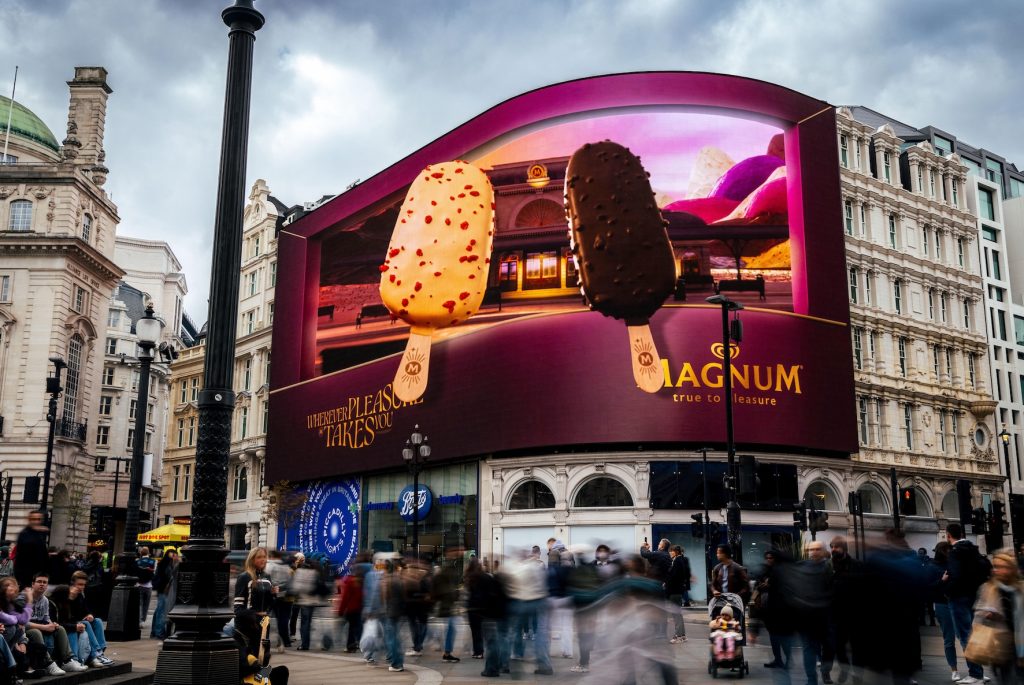
Anamorphic content uses forced perspective and motion-led 3D visuals to create depth illusions on large digital screens. When executed correctly, visuals appear to break out of the screen and interact with real-world surroundings. This dramatic visual disruption instantly captures attention. Additionally, India’s rapid growth in large-format DOOH screens and LED infrastructure has made such executions technically viable. Therefore, anamorphic advertising is shifting from novelty to strategy.
Immersive OOH: Moving Beyond Flat Communication
Immersive OOH is about participation, not passive viewing. Unlike static formats, immersive outdoor media engages multiple senses through motion, scale, realism, and context. 3D visuals, interactive elements, and dynamic content loops transform public spaces into brand experiences. Consequently, outdoor advertising becomes something people stop for, record, and share. This behavioural shift marks a fundamental change in how OOH works in India.
DOOH as the Foundation of Future Outdoor Media
Digital Out-of-Home screens are the backbone of immersive OOH growth. These screens allow dynamic content delivery, time-based scheduling, and creative flexibility. For anamorphic content, DOOH enables precise calibration, brightness control, and motion clarity. As India’s cities invest in smart infrastructure, DOOH networks are expanding rapidly. Therefore, the future of outdoor advertising is inseparable from digital screens.
Social Media Amplification Redefines Outdoor ROI
One of the strongest drivers of anamorphic and immersive OOH adoption is social amplification. Visually dramatic billboards naturally encourage people to capture videos and share them online. As a result, a single outdoor execution can generate millions of organic impressions beyond its physical location. Traditional OOH rarely offered this benefit. Hence, immersive outdoor advertising now functions as both media and content.
Shift from Reach-Based to Attention-Based Planning
Historically, outdoor advertising focused on reach, frequency, and impressions. However, the future lies in attention quality. Anamorphic content delivers higher dwell time, stronger emotional impact, and better recall. Therefore, media planners are gradually shifting from “how many saw it” to “how deeply it was experienced.” This change aligns outdoor advertising with broader attention economy principles shaping modern marketing.
Role of Data, Programmatic DOOH, and Real-Time Triggers
The future of immersive OOH will be increasingly data-driven. Programmatic DOOH allows brands to trigger anamorphic content based on time, traffic, weather, or events. For instance, visuals can change dynamically during peak hours or festive periods. This contextual relevance enhances engagement and efficiency. Consequently, outdoor advertising becomes smarter, adaptive, and more accountable.
Industries Leading the Adoption Curve
Industries driven by launches, aspiration, and visual storytelling are leading the shift. Automobiles, consumer electronics, OTT platforms, gaming brands, luxury labels, and D2C companies are early adopters. These sectors benefit from immersive storytelling and social buzz. Over time, even traditionally conservative industries like BFSI and real estate are experimenting with 3D outdoor formats to signal innovation and trust.
Challenges That Will Shape the Future
Despite rapid growth, immersive OOH faces challenges. Production costs are higher, creative expertise is specialised, and not all locations support forced perspective designs. However, as technology matures and talent expands, these barriers will reduce. Moreover, brands are learning to balance spectacle with strategy. Therefore, the future will reward thoughtful execution rather than blind experimentation.
What the Next 5 Years Look Like for Outdoor Advertising in India
Over the next five years, outdoor advertising in India will become more cinematic, contextual, and interactive. Anamorphic content will move beyond metros into tier-2 cities as DOOH infrastructure expands. AI-assisted creatives, AR integrations, and real-time storytelling will further enhance immersion. As a result, outdoor advertising will no longer be just a reminder medium—it will become a primary storytelling channel.
Conclusion: From Billboards to Brand Experiences
The future of outdoor advertising in India is immersive, digital, and attention-led. Anamorphic content and immersive OOH formats are redefining how brands connect with people in public spaces. By combining technology, creativity, and strategic media planning, outdoor advertising is transforming from static visibility into memorable brand experiences. Brands that adapt early will not just be seen—they will be remembered.