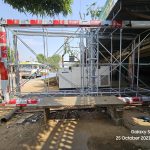

In large-format outdoor advertising, unipole and gantry hoardings are two of the most dominant structures used on highways, expressways, and high-traffic urban corridors. While both formats deliver strong visibility, their manufacturing processes, structural behavior, and engineering requirements differ significantly. Therefore, understanding the difference between unipole and gantry hoarding structures from a manufacturing perspective is essential for media owners, fabricators, and advertisers planning long-term outdoor assets.
This article explains how these two structures differ in design, fabrication complexity, materials, and installation challenges.
Understanding Unipole Hoarding Structures
A unipole hoarding is supported by a single vertical pole anchored to a heavy reinforced concrete foundation. The display frame is mounted at the top of the pole, making unipoles ideal for locations where ground space is limited but height is essential.
From a manufacturing standpoint, unipoles demand high precision because the entire load is carried by one column.
Understanding Gantry Hoarding Structures
A gantry hoarding typically spans across or along a roadway using two or more vertical supports connected by horizontal beams. Gantries are commonly used above highways, toll roads, and arterial routes.
Manufacturing gantries involves handling larger spans and multiple load transfer points, making fabrication more complex than standard hoardings.
Structural Design Differences in Manufacturing
Unipole Manufacturing Design Approach
In unipole fabrication, engineers focus on:
-
Pole diameter and wall thickness
-
Wind load resistance at height
-
Bending moment at the base
-
Heavy-duty foundation anchoring
Since all forces concentrate on one support, unipole structures require thicker steel sections and deeper foundations.
Gantry Manufacturing Design Approach
Gantry hoardings distribute load across multiple columns. Therefore, manufacturing emphasizes:
-
Horizontal beam strength
-
Joint and connection integrity
-
Load sharing between supports
-
Lateral stability across spans
As a result, gantry fabrication involves more components and structural connections.
Material Usage: Unipole vs Gantry
Unipole Hoarding Materials
Unipoles typically use:
-
High-grade structural steel pipes or rolled plates
-
Heavy base plates and anchor bolts
-
Galvanized or epoxy-coated surfaces
Material thickness is generally higher because stress concentration is greater.
Gantry Hoarding Materials
Gantry hoardings use:
-
Structural steel beams and columns
-
Truss systems or box sections
-
Multiple bolted and welded joints
Although individual members may be lighter, total steel consumption is often higher due to the larger structure size.
Fabrication Complexity and Workshop Requirements
Unipole Fabrication Complexity
Unipole fabrication focuses on:
-
Precision rolling and welding of cylindrical poles
-
High-quality full-penetration welds
-
Accurate alignment for verticality
Therefore, fewer components are fabricated, but quality tolerance must be extremely tight.
Gantry Fabrication Complexity
Gantry fabrication is more labor-intensive. It includes:
-
Fabrication of multiple columns and beams
-
Extensive joint welding and bolting
-
Trial assembly in the workshop
As a result, gantry manufacturing requires larger fabrication yards and more manpower.
Foundation and Installation Challenges
Unipole Foundations
Unipole foundations are massive because they counter overturning forces caused by wind. Manufacturing drawings must integrate closely with foundation engineering.
Any fabrication error can amplify stress at the base. Therefore, precision is critical.
Gantry Foundations
Gantry structures require multiple foundations. However, each foundation carries relatively lower load compared to a unipole.
Installation involves aligning columns and beams accurately across road widths, which increases on-site coordination.
Transportation and Erection Considerations
Unipole structures are transported in fewer but heavier sections. Erection requires high-capacity cranes and controlled lifting.
Gantry structures involve transporting multiple components. On-site assembly time is longer, and traffic management becomes a major challenge during installation.
Durability and Maintenance from a Manufacturing View
Unipoles have fewer joints. Consequently, maintenance focuses mainly on corrosion protection and foundation inspection.
Gantries have many joints and connections. Therefore, regular inspection of bolts, welds, and alignment is essential to maintain long-term safety.
Choosing Between Unipole and Gantry: Manufacturing Insights
From a manufacturing perspective:
-
Unipoles are ideal where space is limited and vertical visibility is critical
-
Gantries suit wide roadways where horizontal visibility across lanes is required
The choice depends on location, wind exposure, road width, and long-term maintenance capability.
Conclusion
The difference between unipole and gantry hoarding structures from a manufacturing perspective lies in load distribution, fabrication complexity, material usage, and installation methodology. Unipoles demand precision and heavy foundations, while gantries require extensive fabrication and complex on-site assembly. Understanding these differences helps media owners and advertisers choose the right structure for safety, durability, and visibility.
In outdoor advertising, the right structure is not just about size—it is about smart engineering and manufacturing discipline.