
Outdoor advertising has entered a new visual era where flat screens no longer guarantee attention. As brands compete for impact in visually crowded cities, anamorphic 3D displays and CGI-heavy 3D content have emerged as two powerful but very different approaches. While both use advanced visuals, their effectiveness in real-world outdoor environments varies significantly.
This article compares anamorphic vs CGI-heavy 3D displays to understand what truly works better for outdoor advertising, based on attention, realism, scalability, and brand outcomes.
Understanding the Core Difference Between Anamorphic and CGI-Heavy Displays
Although both formats fall under the umbrella of 3D visuals, they operate on different principles.
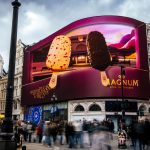
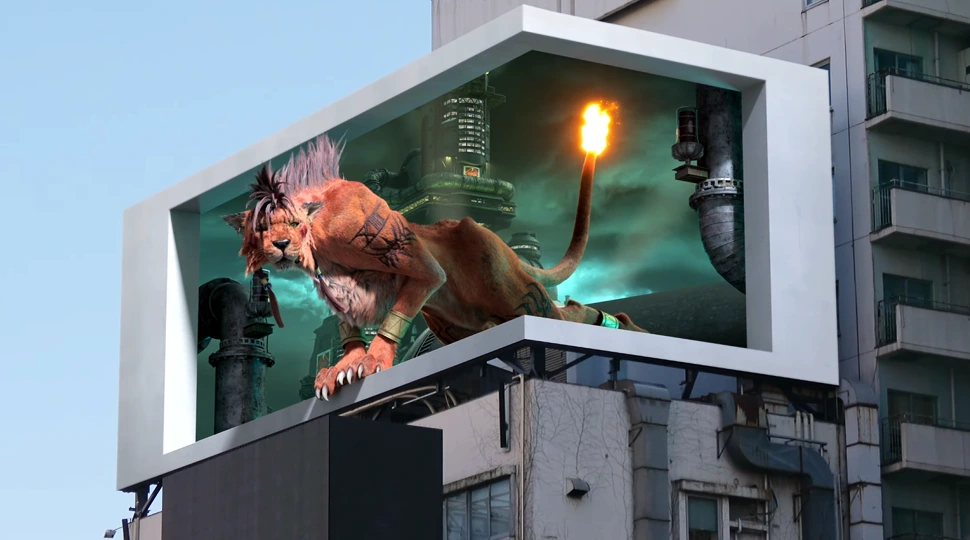
Anamorphic 3D displays rely on perspective distortion designed for a specific viewing angle. As a result, objects appear to extend beyond the screen and interact with real-world space.
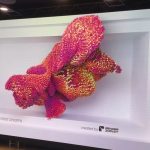
CGI-heavy 3D displays, on the other hand, focus on complex animations, cinematic environments, and visual effects without relying on real-world perspective mapping. These visuals often look impressive on screens but remain visually confined within the display.
This fundamental difference shapes how audiences experience each format outdoors.
Attention Capture: Illusion vs Spectacle
Anamorphic displays excel at immediate attention capture. Because the content appears to break physical boundaries, viewers instinctively stop to understand what they are seeing. The illusion disrupts expectation, which triggers curiosity.
In contrast, CGI-heavy 3D visuals rely on spectacle. While they may look cinematic, they often blend into the visual noise of digital screens. Therefore, attention depends heavily on motion, brightness, or recognisable characters rather than spatial surprise.
In outdoor environments, where distractions are constant, illusion-based disruption usually wins.
Real-World Believability and Environmental Integration
One of the biggest strengths of anamorphic content is how naturally it integrates with its surroundings. When designed correctly, the illusion aligns with building corners, screen edges, and architectural lines. As a result, the content feels embedded in the city rather than layered on top of it.
CGI-heavy displays, however, create their own worlds. While visually rich, they often ignore architectural context. Consequently, the experience feels more like watching a digital screen than witnessing a spatial event.
For outdoor advertising, realism tied to real-world space significantly improves recall.
Viewing Time and Dwell Behaviour
Anamorphic illusions encourage longer dwell time because viewers need extra seconds to process depth and perspective. People often pause, change angles slightly, or record the screen. This behaviour increases engagement organically.
CGI-heavy 3D content is processed faster. Once the animation style is understood, viewers tend to move on unless the narrative is exceptionally strong.
Therefore, when dwell time is a key metric, anamorphic displays consistently outperform.
Scalability and Production Practicality
CGI-heavy content offers flexibility. It can be reused across multiple screens, platforms, and formats with minimal adjustment. This makes it suitable for campaigns requiring scale and consistency.
Anamorphic content, however, is screen-specific. Each display requires custom perspective mapping, angle calibration, and on-site testing. While this limits scalability, it significantly increases impact at premium locations.
Thus, CGI-heavy displays work better for widespread deployment, while anamorphic displays dominate high-impact zones.
Cost vs Return on Attention
At first glance, CGI-heavy 3D may appear more cost-effective due to reusability. However, outdoor advertising is not judged by production efficiency alone. It is judged by attention quality.
Anamorphic displays often deliver:
-
Higher organic social sharing
-
Stronger brand recall
-
Premium brand perception
As a result, their cost-per-attention-second can be lower than CGI-heavy displays, even if production costs are higher.
Social Media Amplification and Virality
Anamorphic displays consistently outperform CGI-heavy visuals in social sharing. Because the illusion only works from specific angles, people actively record and share the moment. This transforms a physical installation into a digital content engine.
CGI-heavy content may be visually polished, but it rarely creates the same “is this real?” reaction. Consequently, it generates fewer organic shares.
For brands seeking earned media value, anamorphic illusions offer a clear advantage.
When CGI-Heavy 3D Displays Make More Sense
Despite their limitations outdoors, CGI-heavy displays are not ineffective. They work well when:
-
The screen architecture does not support anamorphic illusions
-
Campaigns require rapid multi-city rollout
-
Storytelling depends on fantasy environments
-
Budget prioritises reuse across platforms
In such cases, CGI-heavy visuals still deliver strong aesthetic value.
The Ideal Approach: Purpose-Driven Choice
The real question is not which format is universally better, but which format suits the campaign objective.
If the goal is maximum attention, disruption, and memorability at landmark locations, anamorphic displays outperform. However, if the objective is visual richness at scale, CGI-heavy 3D provides flexibility.
Smart brands increasingly use both, reserving anamorphic content for flagship locations and CGI-heavy visuals for networked screens.
Conclusion: Illusion Wins Attention, CGI Wins Scale
In outdoor advertising, attention is the hardest currency to earn. Anamorphic 3D displays win this battle by leveraging human perception and real-world space. CGI-heavy 3D displays, while visually impressive, function more as enhanced screen content rather than spatial experiences.
Ultimately, anamorphic illusions work better when the goal is to stop people, create moments, and drive conversation. CGI-heavy 3D works better when consistency, scale, and storytelling flexibility matter more.
The future of outdoor advertising lies in choosing the right 3D approach for the right environment, not in using 3D for its own sake.