
Brand recall is the true currency of outdoor advertising. While reach ensures visibility, recall determines whether a brand stays in a consumer’s mind after the exposure ends. In today’s cluttered urban environments, traditional static billboards often struggle to achieve this. Consequently, anamorphic content—powered by 3D visuals and DOOH technology—has emerged as a strong alternative. This comparison explores which format truly delivers stronger brand recall and why.
Understanding Static Billboards in Traditional OOH
Static billboards have long been the backbone of outdoor advertising. They rely on size, location, and repetition to build familiarity. Because they remain unchanged for weeks, audiences absorb the message gradually. However, over time, repeated exposure often turns into visual blindness. As a result, recall depends heavily on frequency rather than impact. Moreover, static billboards are limited in how much emotion or storytelling they can convey within a single frame.
What Is Anamorphic Content in Outdoor Advertising?
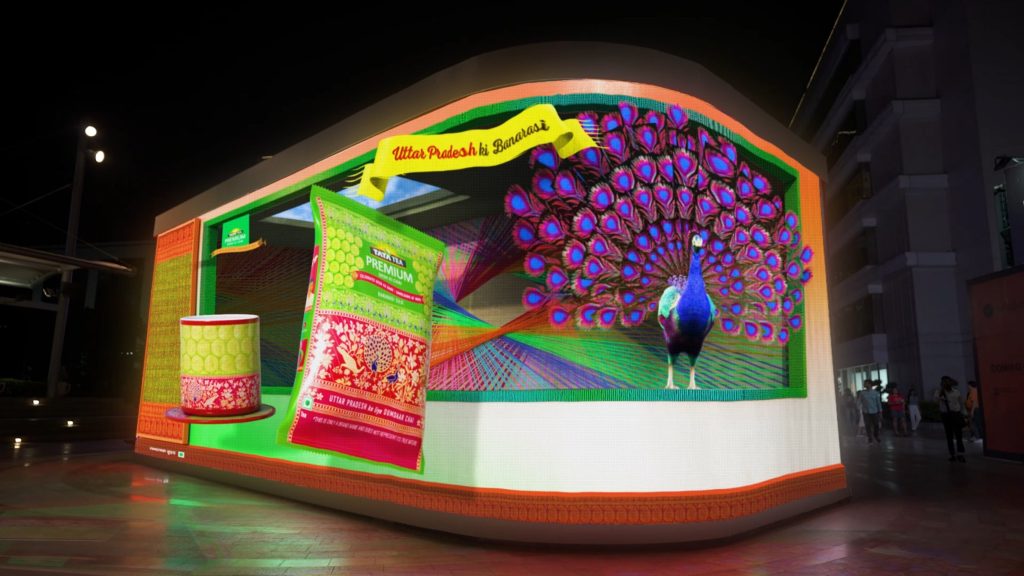
Anamorphic content uses forced perspective and motion-based 3D visuals to create an illusion of depth on digital screens. When viewed from the correct angle, the content appears lifelike and immersive. Unlike static billboards, anamorphic visuals actively engage the viewer’s senses. Therefore, the experience feels surprising, memorable, and difficult to ignore. This experiential nature plays a crucial role in recall generation.
How the Human Brain Processes Visual Memory
To understand recall performance, it is important to consider how the brain works. The human brain remembers novelty, motion, and emotional stimuli far better than repetitive static imagery. Static billboards depend on passive exposure, whereas anamorphic content triggers active attention. Consequently, the brain allocates more cognitive resources to processing 3D visuals. This deeper processing leads directly to stronger memory retention.
Visual Novelty: A Key Recall Differentiator
Anamorphic content delivers immediate visual novelty. Because it disrupts the expected flat visual environment, viewers instinctively pause and look again. In contrast, static billboards often blend into the urban backdrop. Furthermore, novelty creates a “first-time effect,” which significantly boosts recall even after a single exposure. Therefore, anamorphic content often achieves higher recall with fewer impressions.
Emotional Impact and Memory Formation
Emotion and memory are closely linked. Anamorphic content frequently evokes emotions such as surprise, excitement, or curiosity. These emotions strengthen neural connections associated with memory. Static billboards, on the other hand, typically rely on rational messaging or visual repetition. As a result, they struggle to create the same emotional imprint. Hence, anamorphic visuals enjoy an inherent advantage in emotional recall.
Dwell Time and Attention Quality
Recall is not just about being seen; it is about how long the message is processed. Anamorphic billboards significantly increase dwell time. People stop, watch the loop, record videos, and even discuss the visual. Conversely, static billboards are usually consumed in a split second. Longer dwell time leads to better message absorption, which directly improves recall performance.
Social Sharing Multiplies Brand Memory
One major recall advantage of anamorphic content is social amplification. Viewers frequently share 3D billboards on social media platforms. This secondary exposure reinforces memory through repetition across different screens. Static billboards rarely benefit from this effect. As a result, anamorphic campaigns continue building recall long after the physical exposure ends.
Short-Term Impact vs Long-Term Familiarity
Static billboards perform well in long-term familiarity campaigns, especially when sustained over months. They are effective for reinforcing brand presence. However, anamorphic content excels in short-term, high-impact recall situations such as launches, festive campaigns, and announcements. Therefore, the better format depends on campaign objectives. Yet, when the goal is immediate and strong recall, anamorphic content consistently outperforms.
Cost Efficiency from a Recall Perspective
Although anamorphic content involves higher production costs, the cost per recalled impression is often lower. One impactful 3D execution can outperform multiple static placements in recall studies. Static billboards may appear cost-effective initially, but they often require scale and repetition to match recall levels. Hence, from a recall-efficiency standpoint, anamorphic content delivers superior value.
When Static Billboards Still Make Sense
Despite the advantages of anamorphic content, static billboards remain relevant. They work well in highways, rural routes, and mass-reach branding exercises. Additionally, they suit budgets focused on sustained presence rather than creative spectacle. Therefore, static OOH is not obsolete but complementary.
Final Verdict: Which Drives Better Brand Recall?
When comparing anamorphic content vs static billboards, the answer is clear for attention-driven objectives. Anamorphic content delivers higher brand recall due to novelty, emotion, dwell time, and social amplification. Static billboards, while reliable for long-term visibility, struggle to compete in recall intensity. Consequently, brands seeking memorable impact in urban India should prioritise anamorphic 3D formats as part of their OOH strategy.