
Outdoor advertising is no longer limited to visibility alone. Today, brands compete in an attention economy where storytelling determines recall, engagement, and perception. As audiences become visually sophisticated, static hoardings struggle to communicate layered brand narratives. Consequently, 3D billboard visuals—especially anamorphic formats—have unlocked new creative possibilities for brand storytelling. These billboards do not just display messages; instead, they immerse audiences into a visual story unfolding in real time.
How 3D Billboard Visuals Transform Brand Narratives
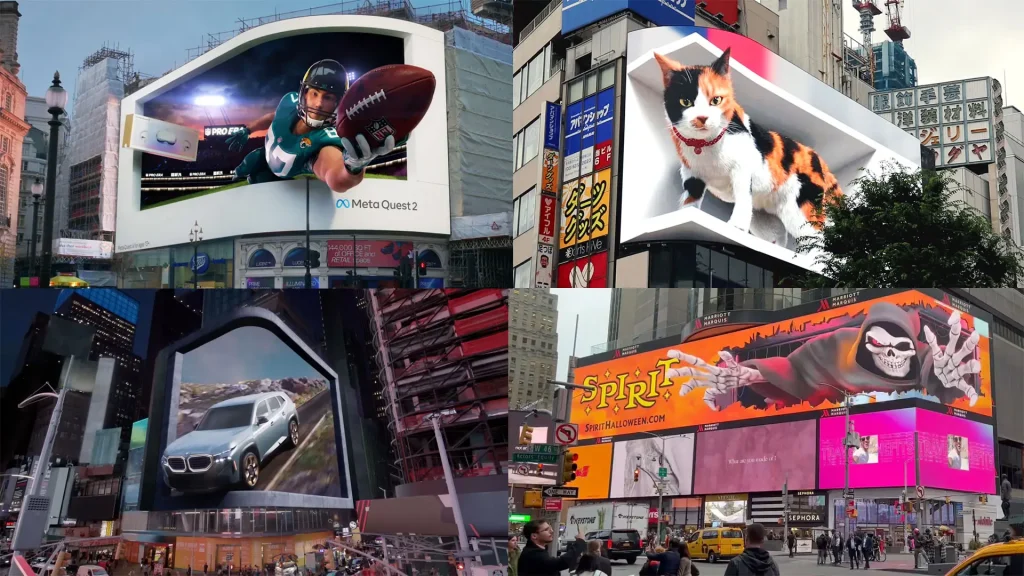
3D billboard visuals use depth, motion, and perspective to turn flat messages into experiential moments. Unlike traditional OOH, where storytelling relies on copy and imagery, 3D billboards allow brands to show rather than tell. Therefore, products appear to break physical boundaries, characters come alive, and narratives unfold within seconds. This transformation enables brands to communicate emotion, innovation, and purpose far more effectively.
Product-as-the-Hero Storytelling
One of the most powerful creative uses of 3D billboards is product-centric storytelling. Brands can present their product as the hero of the narrative. For instance, a smartphone can appear to emerge from the screen, rotate in mid-air, and demonstrate key features visually. As a result, the product becomes memorable without relying on heavy text. Moreover, this approach works exceptionally well for automobiles, electronics, fashion, and luxury brands.
Creating Episodic Stories in High-Traffic Zones
3D billboards also enable episodic storytelling. Instead of a single static visual, brands can design a sequence of animated moments that loop throughout the day. Each loop reveals a different part of the story. Consequently, repeat viewers notice new details every time. This technique is particularly effective in business districts and traffic junctions where daily commuters encounter the same screen repeatedly.
Emotional Storytelling Through Scale and Motion
Emotion plays a crucial role in brand recall. 3D billboard visuals amplify emotion by exaggerating scale and motion. A giant character reaching out of the screen or an oversized product interacting with the cityscape instantly evokes curiosity and excitement. Furthermore, motion-driven storytelling helps brands express emotions like joy, urgency, power, or playfulness within seconds. Therefore, emotional resonance becomes stronger than with flat visuals.
Blending Real-World Context with Digital Creativity
Another creative advantage of 3D billboards is their ability to blend digital visuals with real-world surroundings. Designers can make characters interact with nearby buildings, roads, or urban elements. As a result, the city becomes part of the story. This contextual storytelling feels native rather than intrusive. Additionally, it increases realism, which strengthens audience immersion and believability.
Launch Narratives and Countdown Storytelling
3D billboard visuals are especially effective for product launches and brand announcements. Brands can create countdown-based storytelling, where visuals evolve day by day leading up to a launch. This gradual reveal builds anticipation and curiosity. Consequently, audiences feel involved in the journey rather than being exposed to a single announcement. This approach works well for film releases, OTT premieres, automotive launches, and festive campaigns.
Encouraging User-Generated Content Through Visual Drama
One of the most valuable creative outcomes of 3D billboard storytelling is organic amplification. People naturally record visually dramatic billboards and share them on social media. Therefore, the story extends beyond the physical screen. Traditional OOH rarely achieves this level of participation. In contrast, 3D visuals turn audiences into storytellers themselves, multiplying reach without additional media spend.
Minimal Copy, Maximum Impact Storytelling
3D billboards encourage brands to reduce copy and focus on visual clarity. Because the visuals themselves carry the narrative, messaging becomes simple and intuitive. As a result, even viewers passing at high speeds understand the core idea instantly. This visual-first storytelling is particularly effective in urban India, where multilingual audiences respond better to imagery than text-heavy communication.
Reinforcing Brand Personality and Innovation
Brands using 3D billboard visuals are often perceived as bold, modern, and innovative. Storytelling through advanced visuals signals leadership and forward-thinking values. Meanwhile, traditional hoardings may communicate reach but not innovation. Therefore, 3D storytelling strengthens brand personality and differentiates brands in cluttered markets.
The Future of Storytelling with 3D Outdoor Media
The creative possibilities of 3D billboard visuals will continue to expand. Integration with real-time data, AI-driven creatives, and programmatic DOOH will allow stories to adapt based on time, weather, or audience context. Moreover, as Indian cities invest in premium digital infrastructure, storytelling through outdoor media will become more cinematic and interactive. Hence, 3D billboards represent not just a format but a new storytelling language for brands.