
When it comes to outdoor advertising infrastructure, material selection plays a decisive role in safety, durability, and long-term cost. Among the most commonly used materials in India are Mild Steel (MS) and Galvanized Iron (GI). For media owners and advertisers, understanding MS vs GI structures in billboard fabrication: which is better and why is essential before finalizing fabrication vendors or approving budgets.
Although both materials are widely used, they perform very differently under outdoor conditions. This article explains their differences from a fabrication, durability, and lifecycle perspective.
Why Material Choice Matters in Billboard Fabrication
Billboards are permanently exposed to wind, rain, heat, dust, and pollution. Therefore, the structural material must offer adequate strength and corrosion resistance.
If the wrong material is selected, the structure may suffer from rust, frequent maintenance, or reduced lifespan. As a result, the initial cost advantage can quickly turn into a long-term liability.
What Is an MS Structure in Billboard Fabrication?
Understanding Mild Steel (MS)
Mild Steel is low-carbon steel that is easy to fabricate, weld, and shape. Due to its affordability and availability, MS has traditionally been used in billboard fabrication across India.
MS structures are commonly used for:
-
Temporary hoardings
-
Short-term advertising campaigns
-
Low-height urban billboards
Advantages of MS Structures
From a fabrication perspective, MS offers:
-
Lower material cost
-
Easy cutting and welding
-
Faster fabrication turnaround
Therefore, MS is often preferred when budgets are tight or campaign duration is limited.
Limitations of MS Structures
Despite cost benefits, MS has major drawbacks:
-
Highly prone to corrosion
-
Requires frequent painting and maintenance
-
Shorter lifespan in outdoor environments
Consequently, MS structures demand continuous upkeep, especially in coastal, highway, and high-humidity zones.
What Is a GI Structure in Billboard Fabrication?
Understanding Galvanized Iron (GI)
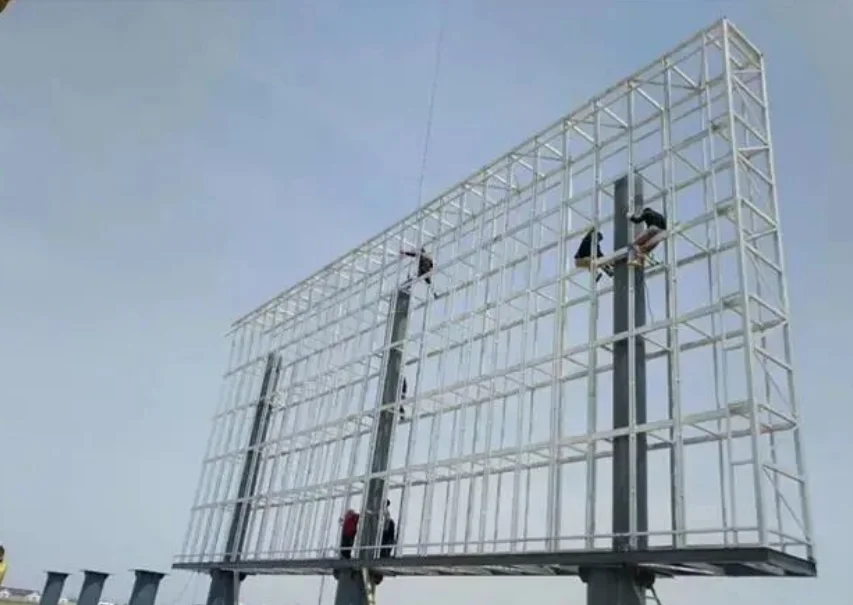
GI structures are made from steel coated with a layer of zinc through a galvanization process. This zinc coating acts as a protective barrier against rust and moisture.
GI is increasingly used for:
-
Highway and expressway hoardings
-
Long-term unipoles and gantries
-
Premium outdoor advertising assets
Advantages of GI Structures
GI structures offer multiple long-term benefits:
-
Excellent corrosion resistance
-
Minimal maintenance requirement
-
Longer structural lifespan
-
Better performance in harsh weather
As a result, GI structures are more reliable for permanent billboard installations.
Limitations of GI Structures
However, GI structures also have some constraints:
-
Higher initial material cost
-
Slightly more complex fabrication process
-
Longer lead time due to galvanization
Nevertheless, these limitations are usually offset by lower lifecycle costs.
MS vs GI Structures: Fabrication Perspective Comparison
Fabrication Ease
MS is easier to cut, weld, and modify. GI fabrication requires careful handling to protect the zinc coating during welding.
Corrosion Protection
MS relies entirely on paint systems for protection. GI has built-in corrosion resistance due to galvanization.
Maintenance Requirement
MS structures require frequent repainting. GI structures require minimal maintenance.
Structural Lifespan
MS structures typically last fewer years outdoors. GI structures can last significantly longer under similar conditions.
Which Is Better for Billboard Fabrication and Why?
Short-Term or Budget Projects
MS structures are suitable for:
-
Temporary hoardings
-
Short campaign durations
-
Indoor or semi-covered locations
In such cases, lower upfront cost may justify the choice.
Long-Term and Highway Installations
GI structures are better for:
-
Permanent billboards
-
Highways and expressways
-
Coastal and high-pollution areas
Although GI costs more initially, it delivers better durability, safety, and lifecycle value.
Cost vs Lifecycle Value: The Key Decision Factor
When comparing MS vs GI structures in billboard fabrication, focusing only on initial cost can be misleading. MS may appear economical at first, but frequent maintenance and shorter life increase overall expense.
On the other hand, GI structures reduce repainting, downtime, and replacement risk. Therefore, from a long-term investment perspective, GI structures are often the smarter choice.
Conclusion
The debate around MS vs GI structures in billboard fabrication: which is better and why depends on usage, location, and campaign duration. MS structures offer affordability and fabrication ease but fall short on durability. GI structures provide superior corrosion resistance, longer lifespan, and lower maintenance, making them ideal for permanent and high-exposure installations.
For media owners and advertisers focused on safety, compliance, and long-term returns, GI structures generally outperform MS structures. In outdoor advertising, durability is not an option—it is a necessity.